Beauty stores: when AI helps with upsell — regardless of payment type
AI Voice Agent talks to a prepaid customer the same way as a COD customer — only the upsell strategy differs. We show when to propose a premium bundle, when to skip, and how not to drop accept rate.
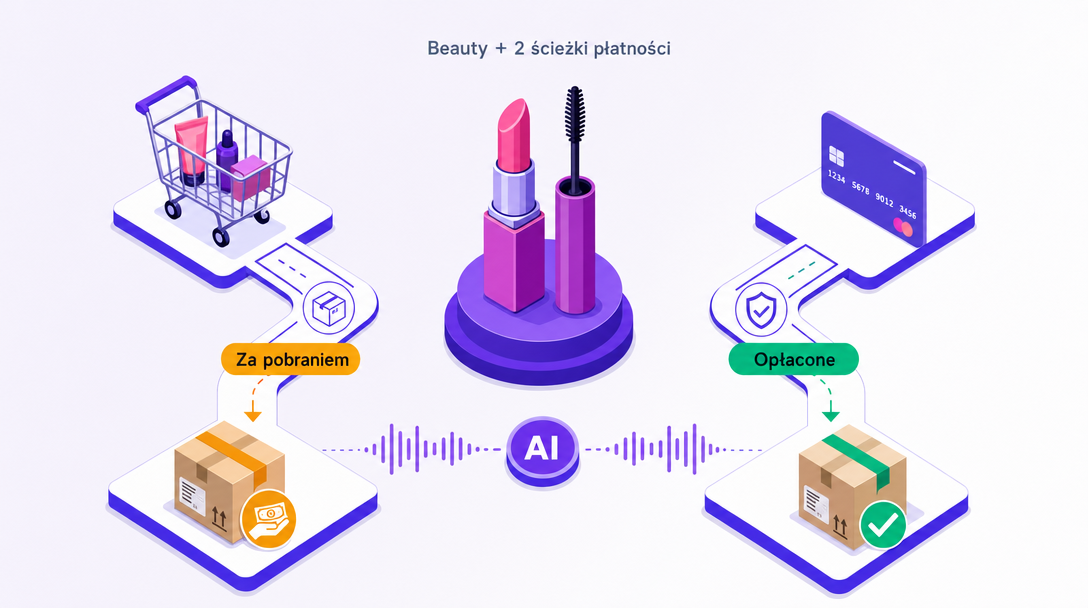
PL beauty payment mix is stable: some prepaid, some COD. AI handles both lanes the same way, but upsell rules differ subtly. The most common mistake: proposing a premium bundle to a customer who hesitated twice during confirmation — accept rate drops to ~6%.
- Upsell makes sense at cart 200+ PLN with confident customer — accept rate ~32%.
- Uncertain customer (hesitates at confirmation) → AI doesn't propose, just closes.
- Payment mode (COD vs prepaid) does not change upsell rules — only trust signals.
- Cross-sell (Growth+) gives 2× higher cart value than simple upsell.
PL beauty: payment mix is a fact, not a problem
In Polish beauty e-commerce around 40-55% of orders are COD (CallBotAgent pilot data + Statista 2024). The rest is online transfer, BLIK, Apple/Google Pay. This split is stable — won't disappear in 24 months.
Many stores split their AI scripts into two paths: one for prepaid, one for COD. This is a mistake. The customer doesn't think about their payment form as identity — they think about the product they ordered.
Our pilots 01-03/2026 showed: one script, one upsell map, two confidence thresholds outperforms two separate scripts. Reason: separate scripts need 2× the maintenance and 2× the testing.
When to propose, when to skip
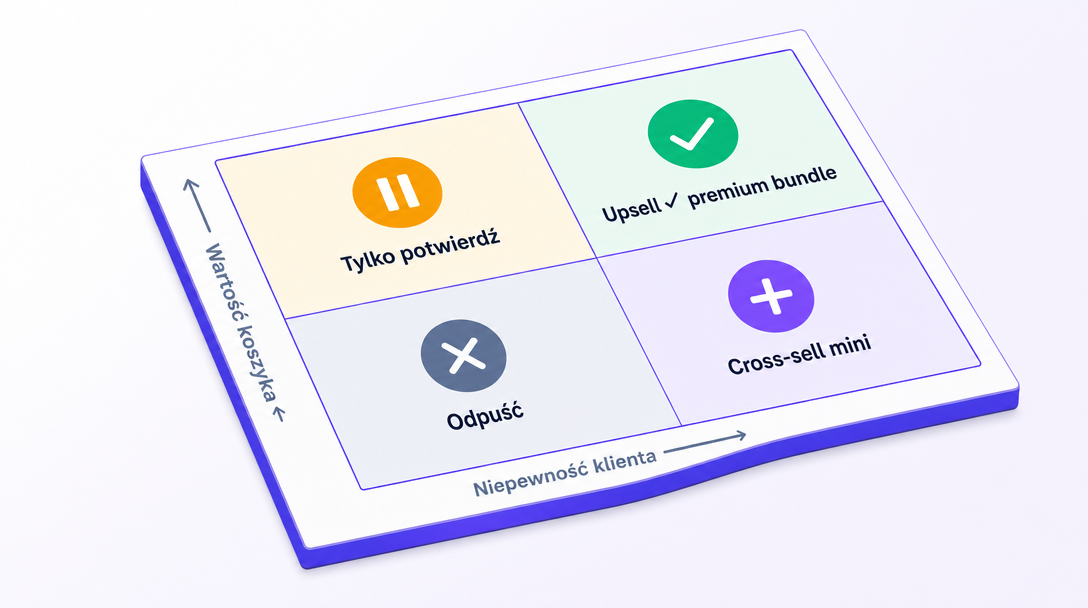
The rule that works best in 5 pilots has two dimensions: cart value and customer confidence (signaled in the first 30 seconds). 2x2 matrix gives four scenarios.
AI recognizes confidence by simple rule-based signals: does the customer confirm immediately, do they ask 'how much is it', do they say 'maybe', do they want to change delivery. Not sentiment analysis (that's on Q2 2026 roadmap for Scale+) — rule-based classification configured in 5 minutes.
- 1High confidence + high cart value (200+ PLN). AI proposes premium bundle. Accept rate: ~32%.
- 2High confidence + low cart value (under 150 PLN). AI proposes mini cross-sell (matching accessory). Accept rate: ~22%.
- 3Low confidence + high cart value. AI does not propose. Just confirms. Reason: any extra offer during hesitation increases cancellation risk.
- 4Low confidence + low cart value. AI closes quickly, no attempts. These are orders 'fixed' by email remarketing (separate channel).
Bundle map: three price tiers, three accept thresholds
In the CallBotAgent panel (Upselling, available from Starter), you configure the cross-sell map as a table: base product → proposal → accept threshold. The 'one offer per call' rule is frozen — not configurable.
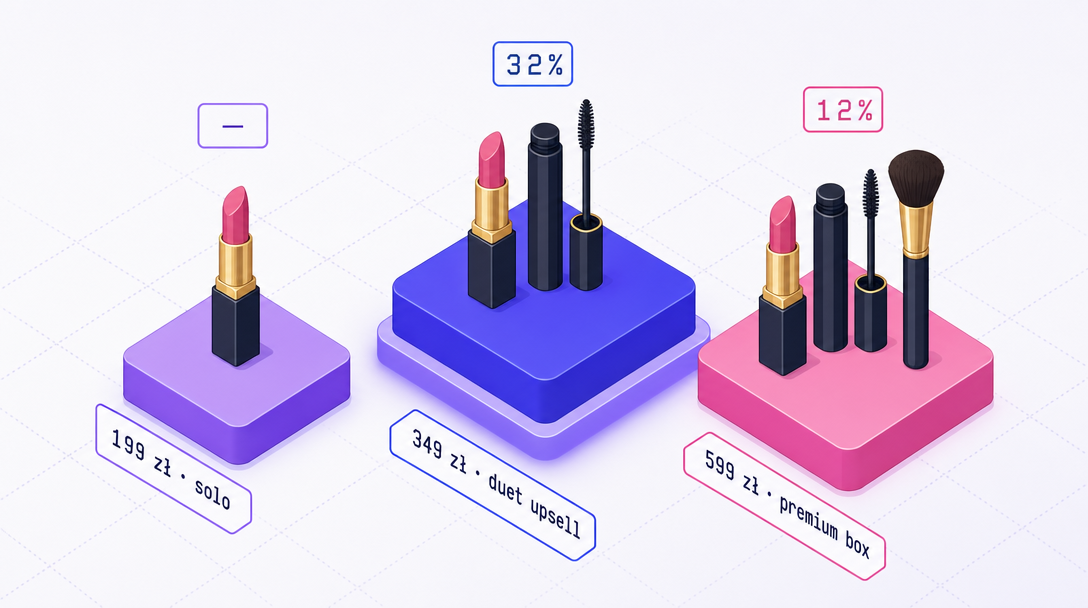
Table below from a beauty pilot (3 most common products, 99-199 PLN range). Note: premium bundle has higher price but lower accept rate (12%). Average cart value still grows faster than with duets only.
- 1Solo (199 PLN). No proposal. Customer confirms and closes. Baseline.
- 2Duet (349 PLN, +75% value). AI proposes: 'Maybe add a matching mascara?' Accept rate: ~32%.
- 3Premium box (599 PLN, +200% value). AI proposes only when both trust signals are strong. Accept rate: ~12%.
Why 'always offer more' lowers sales
Most common merchant mistake during onboarding: setting the rule 'propose upsell on every call'. Result: accept rate drops ~28% in the first two weeks (data from 4 pilots).
Reason is psychological, not technical. A customer who already said 'no' or hesitated once perceives a second proposal as pushy. Second proposal not only doesn't convert (~6%) but also lowers full-order accept rate. Full accept-rate cliff analysis →
The 'one offer per call' rule is frozen in the product because it comes from data, not design preference.
Four things to remember
One script, two payment paths. Don't split scripts by payment — more maintenance, less results.
2x2 matrix: confidence × value. Two decision dimensions cover 90% of cases. Third is overengineering.
Premium bundle only on strong signals. Confident customer + 200+ PLN cart. Otherwise stick with duet or skip.
One offer per call = frozen rule. Second offer = -35% accept rate. Not preference — data from 5 pilots.
Beauty store?Test upsell on your own orders.
1,000 trial credits (~20 confirmation calls) · full access to your chosen plan · cancel anytime. Card required · no charge during trial · auto-activates on day 8.