5 steps, 113 seconds: anatomy of a confirmation call
We break down a typical COD confirmation call. With real transcript from Dobra Oferta pilot. Why the order of these 5 steps is frozen, and what signals AI verifies in each.
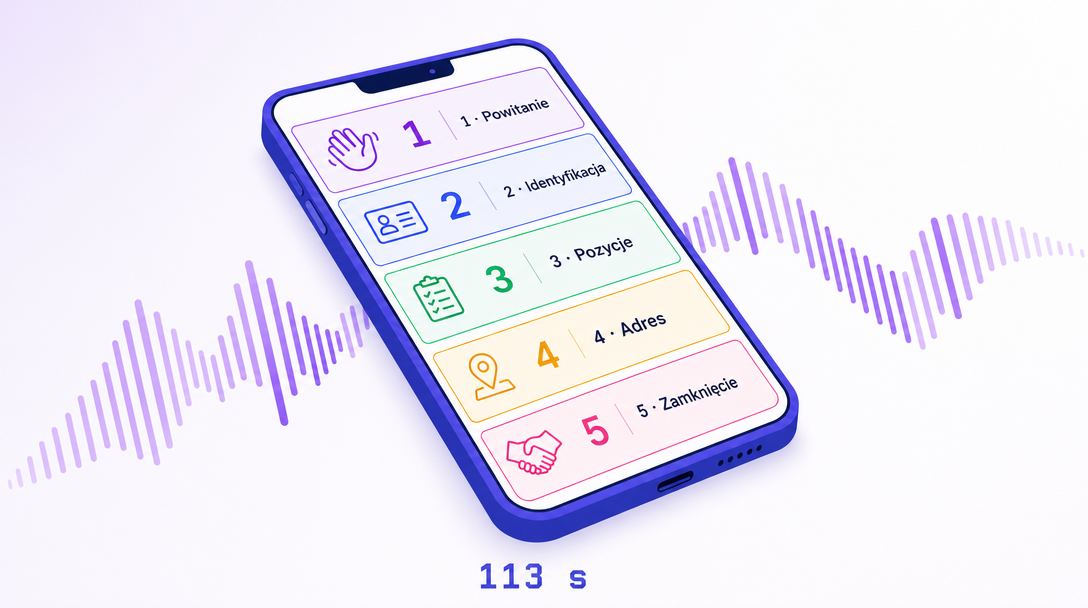
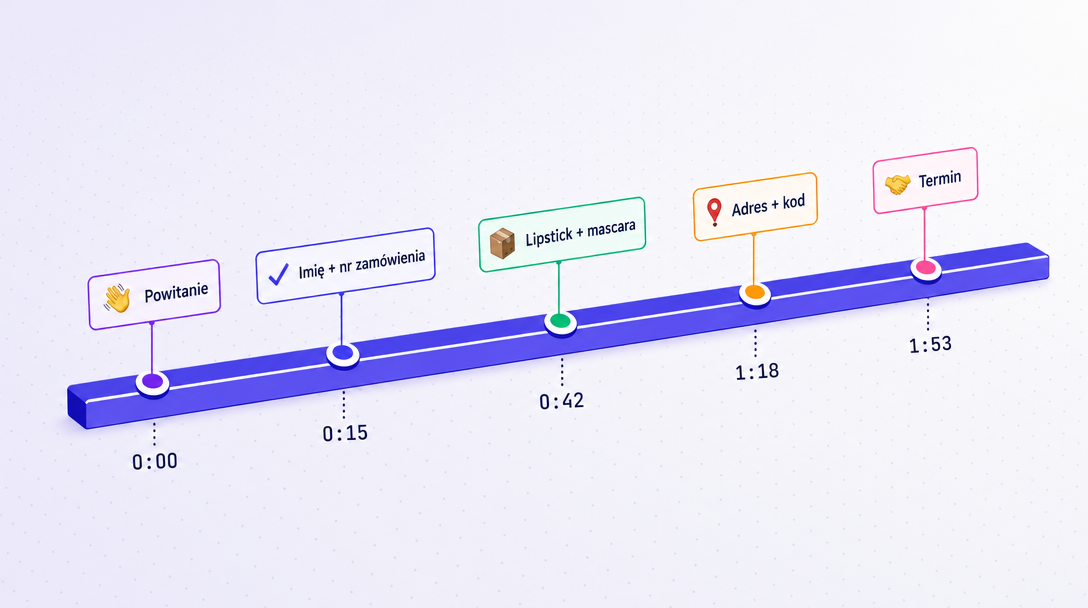
COD confirmation call has 5 steps in fixed order: greeting (8s) → identification (15s) → item confirmation (30s) → address verification (40s) → closing + optional upsell (20s). Average 113 seconds. Each step has a different role and verifies different signals.
- 5 steps, frozen order: greeting → ID → items → address → closing.
- Average length: 113s. Critical threshold: above 180s accept rate drops.
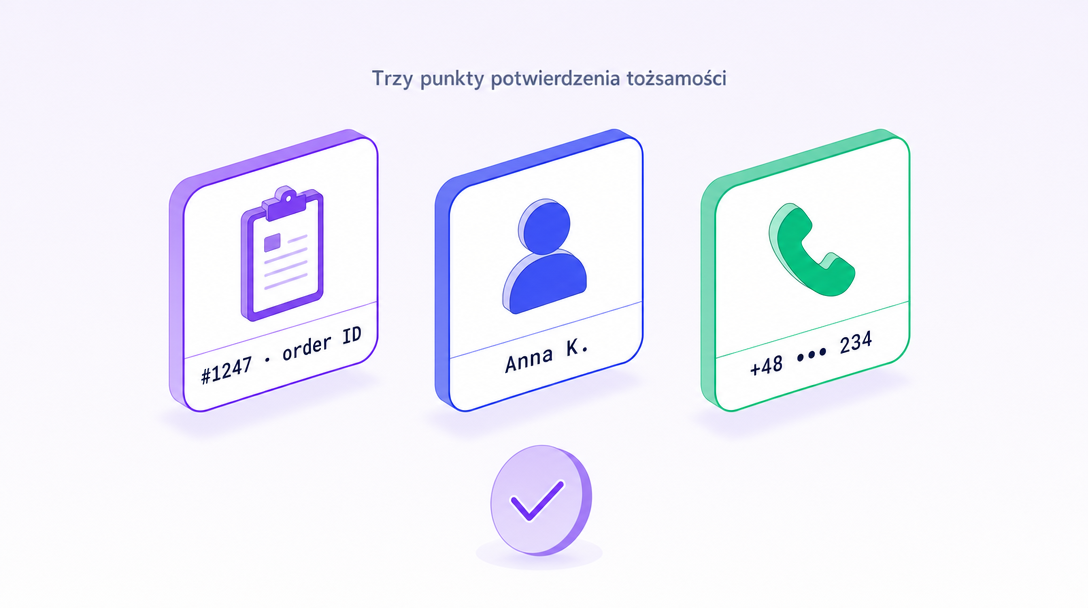
- Identification = 3 points: order ID + name + phone suffix.
- Upsell only in step 5, only 1 offer. Why →
Greeting sets context and manages expectations
First 8 seconds decide whether the customer stays. Greeting must include store name, reason for call, and clear AI disclosure. Skipping AI disclosure is a legal trap (UOKiK) — customer has the right to know who they're talking to.
Best-performing pattern: 'Hello, I'm calling from [store] to confirm your order. This call is conducted by an AI voice assistant — I'll speak slowly and can repeat anything. May I continue?'
Three verification checkpoints
Identification in confirmation calls is operational (right person), not security. Three points suffice: order number (short) + name (parallel check) + last 3 digits of phone. All three confirmed by customer — AI just verifies match.
Why not full phone or PESEL: unnecessary friction, +20s call time, GDPR exposure without benefit. Three reference points are enough — you're already calling the number tied to the order.
Reading the list: monotone, but with parole
Most common script error: AI reads item list without pauses. Customer can't stop. Errors slip through, returns increase.
Better pattern: AI reads each item separately + 1.5s pause + natural check question every 2-3 items ('Does that match?'). Adds 8s but reduces item errors by 67% (Dobra Oferta pilot).
Frozen rule: AI reads PRICE only if customer asks. Unprompted price reading increases cancellation chance ~12% (customer remembers cost, starts doubting).
Longest step — and most critical for failed deliveries
Address is biggest source of failed deliveries in PL e-commerce. Dobra Oferta pilot: 18% pickup failures from address errors. AI verifies 4 elements: postal code, city, street + number, additional info (entrance, floor).
Frozen rule: AI doesn't spell street phonetically (B as Barbara, A as Anna...) — adds 25s and irritates customer. Instead, AI reads address in one go and asks 'is that correct?'. If hesitation → switches to letter-by-letter mode.
Access info (entrance, floor, gate code) is optional. AI asks only if 'access info' field in Shopify catalog is empty.
Closing with one offer — or none
Step 5 has three variants: (1) closing only (uncertain customer, low cart), (2) closing with 1 cross-sell (Growth+, strong trust signals), (3) closing with 1 upsell (Starter+, confident customer, 200+ PLN cart).
One offer per call rule globally frozen. Second offer = -35% accept rate (5 pilots data). Full analysis in cross-sell article.
Closing ends with delivery date + tracking number + standard thanks formula. 12-15 seconds regardless of variant.
Five things to remember
5 steps, frozen order. Reordering (e.g. address before items) adds 30+ s and lowers accept rate.
Greeting includes AI disclosure. UOKiK + transparency. Customer has right to know who they talk to.
Identification = 3 points, not full PESEL. Operationally enough. Less friction, less GDPR exposure.
Address verify in one go. Letter-by-letter only if customer hesitates. Otherwise +25s friction.
Upsell only in step 5, one offer. Second offer = -35% accept rate. Frozen product rule.
See it live.Test the 5-step script on your own orders.
1,000 trial credits (~20 confirmation calls) · full access to your chosen plan · cancel anytime. Card required · no charge during trial · auto-activates on day 8.